Should organizations allow customers to complain?
19th March, 2020
In this globalized world competition is fierce at all levels. Segments once thought of as immune, such as government services enjoying monopoly status within their country, are facing stiff competition from similar institutions in neighboring countries: large organizations compare the services provided in different cities before deciding where they want to establish another international subsidiary. The same goes for SMEs and entrepreneurs, whether they are native to the country or expatriates. In this intense competitive environment, excellence in the service provided is being touted as the great differentiator and has become a critical success factor to all organizations, private or public. Excellence in the service provided will have a direct and positive impact on the competitive position of an organization, a country or a city. The question becomes ‘How can I improve my operations to attract and satisfy my customers?’. The answer is provided by the former chairman of Microsoft when he said that the biggest source for learning and improving is the organization’s dissatisfied customers.
Consequently, the benefits provided by a professional ‘customer complaints management system’ are enormous. If we remember that any organization’s reason to exist is to serve its customers, we begin to appreciate why customers must be the judges who decide whether the service offered is bad, good or excellent. In fact, customer satisfaction (or better yet, customer delight) is one of the top KPIs tracked by all successful organizations worldwide. Cities and countries are competing on this particular KPI to attract new business and investments. Innumerable leaders in business and government have affirmed that the best way to improve is to listen to their customers, particularly the dissatisfied ones, understand why they are dissatisfied and fix what went wrong at the root level. While this is easy to say, it needs a focused effort at the organizational and process levels in order to be effective, and this is where a professionally developed and managed customer complaint system will shine.
The main role of a customer complaint management system is to receive and track every complaint made until resolution. It also helps analysts classify these complaints to uncover root causes and find long term solutions to systemic or human weaknesses. The department or office responsible for the implementation, running and maintenance of this system plays a crucial role in this respect. The responsibilities of the customer complaint management system office include:
- Making sure customers are aware of the existence of the complaint system
- Making sure customer know that raising a complaint is easy and fast
- Making sure employees are aware of what they should do if a customer complains
- Ensuring that the largest number of dissatisfied customers are heard
- Tracking each and every complaint from the time it is raised until resolution
- Letting complaining customers know the status of their complaint throughout the process
- Following up with departments where complaints originated and making sure the analysis of the complaint is conducted properly
- Ensuring dissatisfied customers are engaged and the solution to their problem is explained
- Categorizing complaints and making sure long term solutions are found and implemented
Organizations can utilize the best practices stipulated in ISO 10002. The Standard provides guidance on implementing systems for the management of complaints, from initial report to final resolution as shown the figure below.
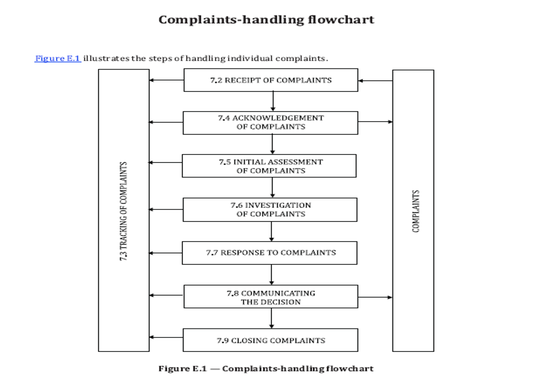
Source: ISO 10002:2018
The competencies required to manage and operate such a system vary and include
- Technical
- IT
- Processes and procedures
- Functional
- Problem analysis
- Problem solving
- Quality management
- Interpersonal
- Influencing
- Communicating (verbal and written)
- Rapport building
- Personal
- Creative thinking
- Critical thinking
This list is obviously not exclusive but it shows the spread of talents needed to manage such an important function. It illustrates the fact that if we are serious about improving our processes in order to maximize customer satisfaction and improve our competitive position, we need to create a department that will professionally manage the complaints system according to international guidelines.
Furthermore, the ISO standard emphasizes the application of the following guiding principles:
Openness: The complaints management process is well publicized, accessible and understood
Impartiality: The avoidance of bias in dealing with the person complained against or the organization
Confidentiality: The protection of the complainant’s and customer’s identity
Accessibility: The accessibility of the complainant to the complaints handling process
Completeness: Finding out the relevant facts
Equitability: Giving equal treatment to all people
Sensitivity: Considering each case on its own merits
A professionally managed customer complaints system will help your organization, your country or your city become a top competitor. By continuously listening to the voice of your customers, the complaint system will highlight the skills your staff need to sharpen and will develop an attitude of serving others. Isn't that the essence of customer centric organizations?
Please check our specialized course tackles the issue of customer complaints by focusing on its two components: the behavioral aspect related to the individual employee who deals face to face with the complainant, and the system's or procedural aspect related to how the organization should process a complaint, every step of the way, from the moment it is raised to its conclusion
About the Author

Related Articles

Conversations with AI: Accounting for Leased Assets by the Lessee
I had a conversation with AI “Claude 3.5” regarding IFRS 16 and the requirement…
nassimo
22nd September, 2024
Read More
Developing Leadership Presence
Leadership presence is a crucial aspect that sets exceptional leaders…
nassimo
20th June, 2024
Read More
Conquering the Tempest
Leadership and resilience, often dormant in individuals, can emerge as…
nassimo
18th April, 2024
Read More
Kaali Peeli Epiphany: Unveiling the Currency of Contentment
Lao Tzu once said The one who knows he has enough is rich. This is an…
nassimo
16th April, 2024
Read More


